Friday, August 22, 2014

What is the benefit of having a queen?

The idea of a monarch is strange to many of us in the US and most of us would probably consider it a waste. However, the situation isn't so simple and CGP Grey provides an excellent explanation of how the UK is actually benefiting quite handsomely from having a monarch.


The short story is that King George III traded his land for a lifetime salary of sorts and allowed Parliament to reap the profits off of the land. It turns out that the land is incredibly profitable and it actually makes a lot of sense to keep a monarch.

I highly recommend you subscribe to CGP Gey if you want to learn more interesting facts and learn answers to fascinating questions.

Friday, August 15, 2014

Are liberals more unhappy than conservatives?


In short, yes.

Over the past 40 years, when asked by the General Social Survey, “Taken all together, how happy would you say you are these days? Would you say that you are very happy, pretty happy, or not too happy?”, self-identified conservatives in general reported feeling "very happy" at rates higher than their liberal counterparts.

Data source: General Social Survey, 1974 to 2004.
Image source: http://freakonomics.com/2008/04/23/conservatives-are-happier-than-liberals-discuss/
However, correlation does not imply causation. There are a number of factors that are even bigger predictors for happiness and in fact, wealth is one of the biggest. This makes sense because with juggling finances and other money-related concerns, there is less time for making yourself happy or taking time for leisure. Any person who has taken an introductory psychology course can probably also tell you this as well because they were probably introduced to Maslow's hierarchy of needs which says that it's pretty hard to focus on bringing esteem into your world when you're focusing on simply maintaining your own physical needs. It also turns out that the richer you are, the more likely you're going to vote republican (probably indicating that you're a conservative). 

Rush Limbaugh tries to make the case that the liberal worldview is one of "pessimism, darkness, and sadness" and then quite shockingly ties this into the suicide of Robin Williams. Rush's lack of decency aside, even if Rush did have access to this data, one would be hard-pressed to prove a causal relationship between the "liberal worldview" and one's happiness or mental health.

However, there is evidence that the conservative worldview or something like it does promote happiness, specifically the belief that the best outcome for society is achieved when individuals work towards their own goals. In a study analyzing how happy subjects were based on whether they performed "self-interested" actions, it was found that participants are much more happy when they do things for their own interests. In the context of politics, Eric Horowitz points out:
Conservatives are more likely than liberals to believe that strong societies are made when people strive for individual greatness rather than concern themselves with collective well-being — i.e. the best way to increase society’s “sum of its parts” is for each part to focus on maximizing its own value. The notion that acting selfish will improve yourself and your society essentially “imposes” self-interested actions on people. If you’re a good person who cares about others you have no choice but to act in a self-interested manner. Because liberals are less taken with this view, they will perceive a real choice between self-interested and prosocial actions, and thus when they do engage in self-interested actions they will derive less happiness from them. 
As much as I hate to admit it then, Rush might be right about the liberal worldview to an extent. But is liberal unhappiness really a bad thing? If liberals aren't as happy when they serve their own needs, then maybe they're more receptive to the growing income inequality in this countrythe imminent threat of global warming and the next mass extinction, or the fact that minorities are disproportionately affected by our criminal justice system. If that's the case, then maybe these are good things to be unhappy about.


Monday, August 11, 2014

State fair season is coming

Image courtesy of the Minnesota Daily

To get ready, check out this description of a culinary crusade at the Indiana state fair.

Friday, August 8, 2014

How is AOL making any money?

When bored, you can replace AOL with LOL everywhere it appears on the AOL site for a great deal of amusement.

To be quite honest, I hadn't heard about AOL or even thought about AOL in quite a long time but an article today informed me that it turns out they're actually making quite a bit of money. AOL (known as America Online in yesteryear) has recently made a business model out of purchasing content companies such as the Huffington Post and other news outlets. But as it turns out, this isn't primarily where their profit is coming from.

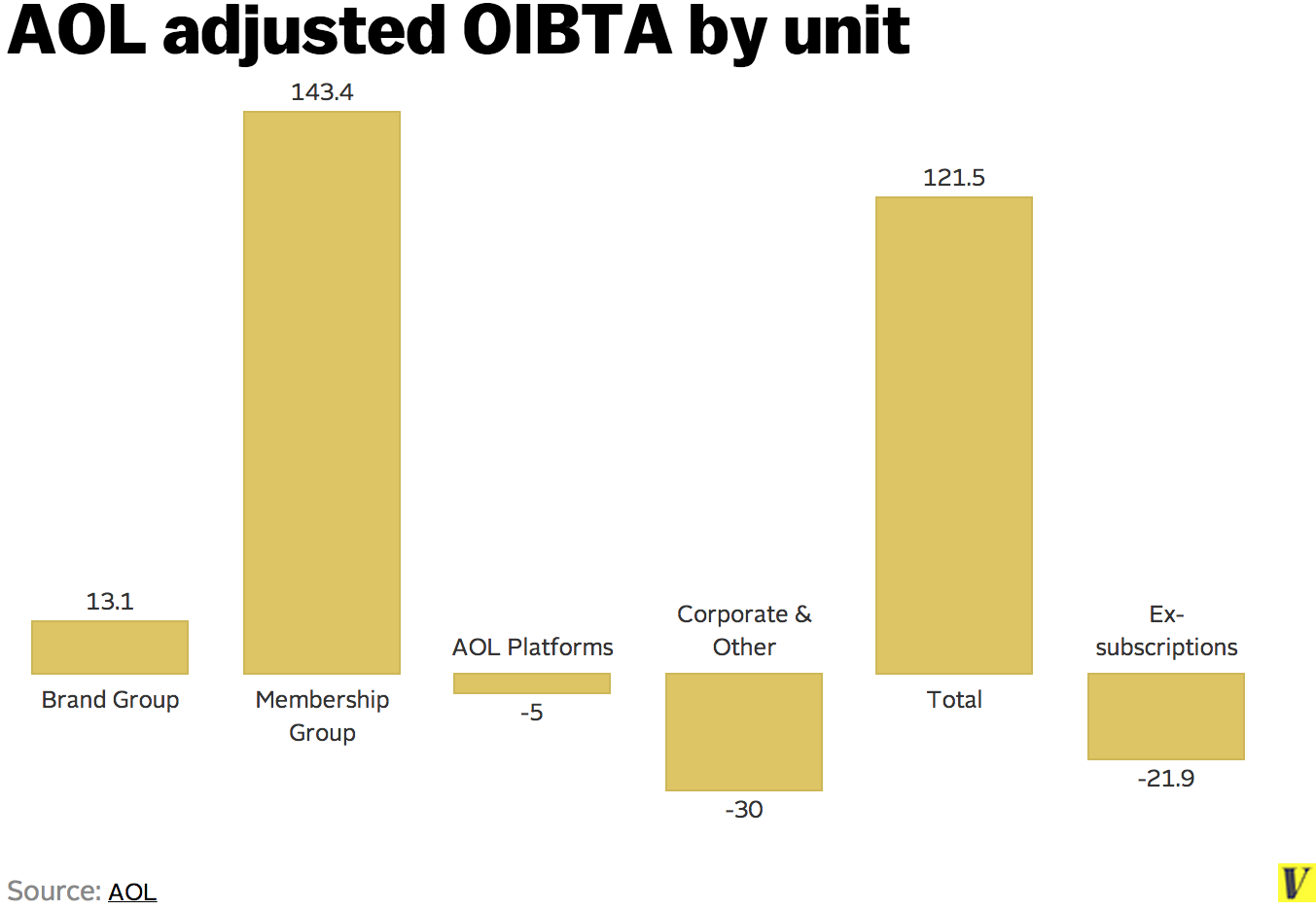
According to AOL's most recent earnings report, most of their profits come from what they call the "Membership Group". You can find the breakdown of their profits organized into a more compact form by Matthew Iglesias over at Vox that I'm showing below:


Iglesias attributes these large profits to people who simply forgot to cancel their AOL subscriptions even though they haven't touched a dial-up modem in years. It is true that the number of households in the US that still use dialup is at a record low of 3%, but that isn't necessarily the only service they provide any more.

If you take a look at the benefits for signing up for an AOL subscription, membership in AARP (only if you're old enough of course) is listed on every plan and the other "features" are grouped into services that either protect your identity, give you "membership deals", offer some sort of convince, or protect your computer. At the bottom of that list is of course dial-up internet access but that service is not what is prominently advertised. Of course most of these things are either available for free in another form or simply aren't of any real value to anybody, but history tells us that people will always succeed at selling us stuff we don't need.

To me, it appears that the success of the AOL subscription model is not to provide dial-up internet access, but to also provide services that are overwhelming geared towards technically challenged (or illiterate) individuals, namely the elderly. The AOL plans bill themselves as aids to navigating the internet safely and simply, which, as any person who has helped a senior citizen with their tech needs knows, is one of their biggest concerns. These users are also probably less aware of free alternatives, rely on brands they "trust", and really don't know how to evaluate the costs and benefits of these services.

That said, AOL is currently losing subscribers and the rate just keeps increasing so people in general don't want what AOL has to offer. My guess is that AOL subscribers are more afraid of changing their habits in an uncertain wired[/wireless] world than spending between $7 and $26 per month and potentially losing some semblance of familiarity. Either way, this isn't a sustainable business model for them.

Wednesday, August 6, 2014

The animated GIF is for more than just memes


It isn't very often that you hear the animated GIF referred to as anything other than an internet meme.
Artist Erdal Enci, however, uses the it as a brilliant artistic medium for making some mind-bending animations. He overlays videos of himself doing various things often with extremely long exposures. The result is an incredible interplay between light, motion, and pattern.

Gerrymandering can actually be a good thing

Gerrymandering is one of those words that carries a bit of a dirty, slimy connotation with it. Even if you don't know what it means, you've probably heard it before and you probably heard it in the context of everything that is wrong with our political system.

In short, Gerrymandering is the redrawing of congressional districts in order to favor incumbents or to give an advantage to one party. These districts are redrawn every time a US Census comes out and are often drawn by the state legislature. In order to effectively gerrymander the congressional districts, these legislatures will divide the state's electorate into districts such that the opposition party is either concentrated into districts they will lose or into districts they'll win by a landslide.

For example, let's say that a state is composed of 50% people who vote Democrat and 50% people who vote Republican. Let's also say that the sate has 10 representatives. If the state were accurately represented, it would have 5 Democratic and 5 Republican representatives. But let's say the state legislature is controlled by the Democrats and they draw the districts such that the Republicans are concentrated into three districts and so that they will have overwhelming margins of victory (greater than 30%). This means that if that state evenly distributes the remaining Republican voters into the other 7 districts, Democrats will have a majority of sympathetic voters in each of these districts (albeit a smaller majority than in the heavily Republican districts) and will likely elect Democrats from all of the seven. So now a state that was evenly divided between the two parties is a solid blue state. This is a bit of an extreme case but it illustrates the point and it's not far off.

When a sufficiently large number of districts are gerrymandered, it allows situations like in 2012 when the majority of the voters in the United States voted for Democrats in the midterm House elections but republicans were elected to a majority of the seats. Because the Census is only conducted every 10 years, the next redistricting will happen in 2021 and it is very likely that the House will be controlled by Republicans until and perhaps after then (it was dominated by Democrats for 40 years until 1998 due in part to gerrymandering).

What then might the US look like if there was no gerrymandering whatsoever? Well, it might look like this:
The United States of Polygons. Image courtesy of Vox.
This method is described by Andrew Prokop over on Vox and consists of splitting states into regions with roughly the same population using the shortest possible line. As a result, you get a lot of districts that are rectagular and very few stretched districts unless there are adjacent cities or wide uninhabited areas.

But is this any better than the current system? John Sides over at The Monkey Cage doesn't think so. What you gain in terms of being unbiased, you lose in terms of representation. Specifically, Sides' take on good representation is this:


  • Good representation happens when representatives are beholden to specific geographical communities, who are believed to have common interests.  This is a reason to draw districts that correspond to existing cities, towns, and the like.
  • Good representation happens when the largest possible majority of people get to elect the representative of their choice.  This is a reason to draw lopsided districts with large partisan majorities.
  • Good representation happens when groups who have been historically excluded from the electoral process — like racial and ethnic minorities — get to elect the representative of their choices.  This is a reason to draw majority-minority districts (like the snakey NC-12, the subject of Shaw v. Reno and subsequent Court cases).
  • Good representation happens when a district is politically competitive, which means representatives work harder to represent “the people” because there is always a good chance they could be thrown out of office.  This is a reason to draw districts with a partisan balance close to 50-50.
  • A straight-line system is unlikely to accomplish any of these in very many districts. Obviously in the map above, representatives aren't even beholden to specific states which could cause a lot of problems.

    So is there a solution? Well maybe. Several other countries have set up independent commissions to redraw their political zones but it doesn't always work and they aren't always fair. For instance, in order to represent a minority in a country, it makes sense to create districts that are majority-minority, but these also tend not to be very competitive. So often the criterion for good representation are at odds with each other.

    What's the take-home message? As in all things, the problem is much more nuanced than many would have you believe and there are rarely so-called "common sense" approaches.

    If any of you have any possible solutions to gerrymandering, post them in the comments.

    Tuesday, August 5, 2014

    Why on earth would you (or me) want to start a blog?

    Because the most ridiculous stock images involve fists.
    I remember the first time I was invited to join Facebook. At the time, it was mainly for just posting pictures (in albums with odd arbitrary limits) and learning tidbits about how other people are (remember Facebook started with status updates that were titled like "Jeff is..."). But how much can we really convey about who we are simply through a status update. True, Facebook has since dropped the "[name] is" prefix from their status updates but the purpose remains the same; we want to tell the world (or a subset of it) a little about ourselves.

    That is the goal of all social media but how much can we really express ourselves in such amputated forms as Twitter's 140 characters or any of the other forms of social media* out there? Because of this, I've decided to start a blog.

    For the past few years, I've begun to realize that blogs are really beginning to define my daily reading routine. To me, these blogs have replaced most of my other sources of daily news and indeed, if I see a news story developing on Google News for instance, I will scan my favorite blogs to see who is covering them. If I read so many blogs, I figured I might as well start one.

    Before I go any further, I should give specific shout-outs to my friends Lauren, Josh, and Lisa for blazing the path before me. Although I haven't followed all of their blogs religiously over the years, every time I read them I envy the fact that their thoughts, ideas, and personalities are simply on display for the world to see. Each time I've been reminded of their blogs, I have pushed myself a little more to figure out whether I should start a blog or not.

    In the title of this post, I posed the question why should you start a blog mainly and not why I started a blog. And honestly the answer to that question is varied and complex for each individual. If you google around, you'll find many reasons why you should start a blog and why it will make you a better person in whatever you're doing. A lot of these benefits are really quite remarkable and can really only be achieved through blogging. And after you decide to start a blog, you can search for any number of resources that will guide you through crafting an excellent blog.

    Beyond these benefits though, I like to focus on blogging as the act of writing. On his blog (which I just found), Jeff Goins provides the three simple reasons why he writes:

    I write to express. I feel like myself when I’m writing. I write not for the purpose of being published or the intention of being read, but for the thrill of putting pen to paper. I write for love of the craft, for the sake of writing itself.
    I write to understand. I do not write because all the answers are in my possession. I write for the same reason Flannery O’Connor did — because I don’t know what I think until it is written. Because by writing, I am able to see things more clearly.
    I write to remember. Writing lets me grasp life in ways that would otherwise escape me. It helps me connect with God and the universe and reminds that I’m still breathing and there’s a reason why.
    These are the quintessential reasons why I think anybody should start a blog. There are numerous outlets for writing and more importantly for sharing your writing (hence why I began this discussion with social media) but a blog offers a most effective way of both achieving these three things as well as connecting with an audience. There are certainly less lofty goals for starting a blog such as marketing or simply because its expected of you in your career but we can choose what we get out of an experience.

    This blog I intend to be an exploration of my own writing and ideas on everything I am curious about. In some ways, this will be an outgrowth of my Facebook feed where I post articles and opinions that I have learned something from but this also will be my writing outlet. Facebook does not provide me the space with which I can write these long posts and enjoy all of the true benefits of blogging. As the reader, I hope that you will come away from this blog with a perspective you have not considered or a piece of information that you were unaware of before.

    --
    *I do not profess to be an expert in social media nor am I even remotely familiar with all of the options available to me out there. I just want to add this because I'm sure that somebody out there will say that there is certainly some form of social media out there that I haven't tried yet. That may very well be true but that's another reason why I started a blog. I want to learn more and maybe this post will lead me to the veritable nirvana of social media sites. Who knows!