Saturday, November 8, 2014

Seeking effective treatment for mental illness in the US can be very difficult

Mental Illness and Curing series by Carlie Simpkin.

Behind obesity, mental illness is one of the most prevalent diseases in the United States. A study in 2003 estimated that between 1 in 4 and 1 in 3 adults adults report experiencing at least a mild mental illness within the past 12 months. To answer this need, Americans spent $57 billion on mental healthcare in 2006 which was used to treat 13% of the adult population (for those doing the math at home, that's roughly $1460/person in 2006). This also means that more than half of those with mental illnesses are not seeking treatment (more on this shortly). But how effective are some of these treatments and are we really getting our money's worth?

First, let's look more closely at a very specific mental health disorder: alcohol dependence. In a study in 2007, it was found that 4.7% of the US population had abused alcohol in the past 12 months with 3.8% being classified as dependent. The same study found that the lifetime prevalences of alcohol abuse and dependence were 17.8% and 12.5% respectively. Sure, depression is more prevalent  9% of the adult population reporting depression in the past 12 months and with 6.9% of adults reporting a major depressive episode in the same period, but treatment for alcoholism is somewhat unique in that it has been institutionalized in the form of Alcoholics Anonymous.

AA is a brand that just about everybody has heard of and for good reason. With more than 1.3 million active members and countless more who have at least been exposed to the program, the chances that a person with an alcohol problem will seek (or be required to seek) treatment through AA is quite high. But does it actually work?

A little while back, a number of news articles (including those from NPR and Salon) have been coming to the damning conclusion that AA simply isn't effective. The sudden genesis of these stories stems from the recent book by Lance and Zachary Dodes called The Sober Truth: Debunking the Bad Science Behind 12-Step Programs and the Rehab Industry where the authors show a lot of the shortcomings of many 12-step programs. To be sure, commercials for luxurious rehab programs are quite common on TV these days and with enough budget for national ad buys, these rehab facilities must be making some serious money whether or not they are actually helping patients. But when one reads these articles, one must keep in mind the difference between AA and the more generic category of 12-step programs: AA is, for the most part, a collection of support groups that reside under the umbrella of the general 12-step program category. While the 12-step program is often monetized in the form of fancy resorts and expensive distractions from addiction, AA is a bare-bones organization that is free to its members and subsists on small donations from these members.

So again, does AA work? According to Dodes, no it does not. Dodes' even says that AA can actually do more harm than good by forcing people to blame themselves for being "weak" or by using a bit of a square-peg-in-a-round-hole approach by trying to fit everyone into the same model. To be fair, Dodes does concede that AA can work for some people but that this is only 5-10% of the people who actually enter the program. And with many people entering the program as part of a court order or through a will other than their own, it's easy to understand why this wouldn't work for them.

But of course there is more to it than this. After several news organizations published excerpts from Dodes' book or published interviews with him, there was a flurry of responses in defense of AA. These responses also came from the psychiatric community with a notable article being published by two Harvard Medical School professors. They actively criticize the claims that Dodes makes and go on the offensive against his book, citing additional studies and claiming that Dodes misinterpreted the studies in his book. Dodes even fights back in the comments and you can decide for yourself who is the victor there. Another article paints an extremely rosy picture of AA that contrasts starkly to the gloomy picture that Dodes creates, and describes AA as a "modern miracle". While I think the modern miracle claim is a bit overblown, the article does strike at the heart of what makes AA successful.

So what is the take away message here? Well, with something as ubiquitous and well-established as AA, there is no consensus on whether it actually helps most of the people who use it. My impression is that one can cherry-pick results to prove either point and that in general, addiction is a highly personal experience that requires personal care. This is perhaps the one point that both sides agree on and it is on whether AA can provide this individualized care that the sides disagree. Having had close relatives that went through AA, I can attest that it does work in certain circumstances but that it may not work for everybody.

One of the key tenants of AA is that you must surrender to a higher power and this is a key area that Dodes takes issue with. The idea certainly carries religious overtones but if you ask most AA members, they will tell you that the idea is not overtly religious but more about removing ego from the equation. Similarly, AA forces its members to admit that they are drunks and addicts because it is very easy for a person to say, "I'm not like these people... I don't have their problems" and believe that they can go back to drinking/using/etc without it becoming a problem again; in other words, their ego clouds their perception of how much control they are actually exercising. Admitting that you actually do have a problem and surrendering your will to whatever higher power you can find is a step that allows you to take control of what you can instead of attempting to control something that clearly is controlling you. Not everybody is ready to part with their ego and so they will have a lot of problems with this step in AA. Another piece of the AA gospel is that you must hit "rock bottom" in order to actually rebound. Rock bottom is relative and only signifies the point at which a person has hit the point at which they don't wish to return. Again, people who are forced into the program or who otherwise believe they are in control of their addiction will not have reached "rock bottom" in the AA sense. So there may be very many reasons why AA doesn't work but it seems to me that the overall problem is that the message of AA may not be what some people want to hear.

The second and even bigger issue here is not actually treating the illness but simply getting people to seek help when they do have a problem. Perhaps the single most moving piece for me after the death of Robin Williams was this piece in the Washington Post Wonkblog that highlights how despite Americans now knowing more about mental illness than ever before, there is still a significant stigma surrounding mental illness:
Those improvements in understanding mental illness, however, didn't help reduce the social stigma, researchers found. People were more likely to say they didn't want an alcoholic to marry into the family (up from 70 percent to 79 percent) or have someone with schizophrenia as a neighbor (up from 34 percent to 45 percent). Most in 2006 also said they were unwilling to work closely with someone who had schizophrenia (62 percent) or alcohol dependence (74 percent), and most thought people with either illness would likely be violent.
And the most telling figure from the article shows the barriers for those seeking mental health treatment:

(U.S. Department of Health and Human Services) via WonkBlog
If one adds together the categories that could be considered stigma (confidentiality issues, community views, others finding out, negative effect on job), they add up to 35.4%, making it the second greatest barrier to seeking mental health care behind cost.

And this is just on average for all mental health issues. In the case of pedophilia, the people trying to come to grips with their problem are also facing the possibility of imprisonment if they confide in the wrong person. For these individuals who want to stop their behavior before hurting somebody, there are precious few places to turn. To learn more, I highly recommend the fantastic article in Medium dealing with the struggle of one boy to overcome his attraction to young children and forming a support group for those like him. The article will open your eyes to what shame really is and will cause you to question where the line should be drawn between punishment and rehabilitation.

Mental health is a real issue in this country and deserves serious attention. There is no quick fix for our country's problems but the first step in recovery is admitting you have a problem. The second step is to recognize that getting help is actually a sign of strength, not weakness. The more that we as a nation can accept this, the further we will progress towards treating mental illness.

If you have any stories about mental illness, the stigma around it, or any other thoughts, please comment below!

New Posts Coming Soon


Sorry for the gap in output here. I've had a wonderfully busy fall that has relegated me to simply thinking about issues as opposed to writing about them, but it feels good to get back to the keyboard and hash out some of my ideas.

I've had a number of posts in draft form for a long time (my drafts are actually beginning to outnumber my actual posts) and there are a lot of things that I'd like to write about but which require a significant amount of research and thought. True to my nature, I've done both but not all in the same place.

The drought ends today though because I'm preparing a post on mental illness and specifically on addiction. Mental illness is one of the most prevalent medical problems in this country (behind obesity) and I have been giving it a lot of thought since the death of Robin Williams and the many articles that followed it.

Stay tuned!

Friday, August 22, 2014

What is the benefit of having a queen?

The idea of a monarch is strange to many of us in the US and most of us would probably consider it a waste. However, the situation isn't so simple and CGP Grey provides an excellent explanation of how the UK is actually benefiting quite handsomely from having a monarch.


The short story is that King George III traded his land for a lifetime salary of sorts and allowed Parliament to reap the profits off of the land. It turns out that the land is incredibly profitable and it actually makes a lot of sense to keep a monarch.

I highly recommend you subscribe to CGP Gey if you want to learn more interesting facts and learn answers to fascinating questions.

Friday, August 15, 2014

Are liberals more unhappy than conservatives?


In short, yes.

Over the past 40 years, when asked by the General Social Survey, “Taken all together, how happy would you say you are these days? Would you say that you are very happy, pretty happy, or not too happy?”, self-identified conservatives in general reported feeling "very happy" at rates higher than their liberal counterparts.

Data source: General Social Survey, 1974 to 2004.
Image source: http://freakonomics.com/2008/04/23/conservatives-are-happier-than-liberals-discuss/
However, correlation does not imply causation. There are a number of factors that are even bigger predictors for happiness and in fact, wealth is one of the biggest. This makes sense because with juggling finances and other money-related concerns, there is less time for making yourself happy or taking time for leisure. Any person who has taken an introductory psychology course can probably also tell you this as well because they were probably introduced to Maslow's hierarchy of needs which says that it's pretty hard to focus on bringing esteem into your world when you're focusing on simply maintaining your own physical needs. It also turns out that the richer you are, the more likely you're going to vote republican (probably indicating that you're a conservative). 

Rush Limbaugh tries to make the case that the liberal worldview is one of "pessimism, darkness, and sadness" and then quite shockingly ties this into the suicide of Robin Williams. Rush's lack of decency aside, even if Rush did have access to this data, one would be hard-pressed to prove a causal relationship between the "liberal worldview" and one's happiness or mental health.

However, there is evidence that the conservative worldview or something like it does promote happiness, specifically the belief that the best outcome for society is achieved when individuals work towards their own goals. In a study analyzing how happy subjects were based on whether they performed "self-interested" actions, it was found that participants are much more happy when they do things for their own interests. In the context of politics, Eric Horowitz points out:
Conservatives are more likely than liberals to believe that strong societies are made when people strive for individual greatness rather than concern themselves with collective well-being — i.e. the best way to increase society’s “sum of its parts” is for each part to focus on maximizing its own value. The notion that acting selfish will improve yourself and your society essentially “imposes” self-interested actions on people. If you’re a good person who cares about others you have no choice but to act in a self-interested manner. Because liberals are less taken with this view, they will perceive a real choice between self-interested and prosocial actions, and thus when they do engage in self-interested actions they will derive less happiness from them. 
As much as I hate to admit it then, Rush might be right about the liberal worldview to an extent. But is liberal unhappiness really a bad thing? If liberals aren't as happy when they serve their own needs, then maybe they're more receptive to the growing income inequality in this countrythe imminent threat of global warming and the next mass extinction, or the fact that minorities are disproportionately affected by our criminal justice system. If that's the case, then maybe these are good things to be unhappy about.


Monday, August 11, 2014

State fair season is coming

Image courtesy of the Minnesota Daily

To get ready, check out this description of a culinary crusade at the Indiana state fair.

Friday, August 8, 2014

How is AOL making any money?

When bored, you can replace AOL with LOL everywhere it appears on the AOL site for a great deal of amusement.

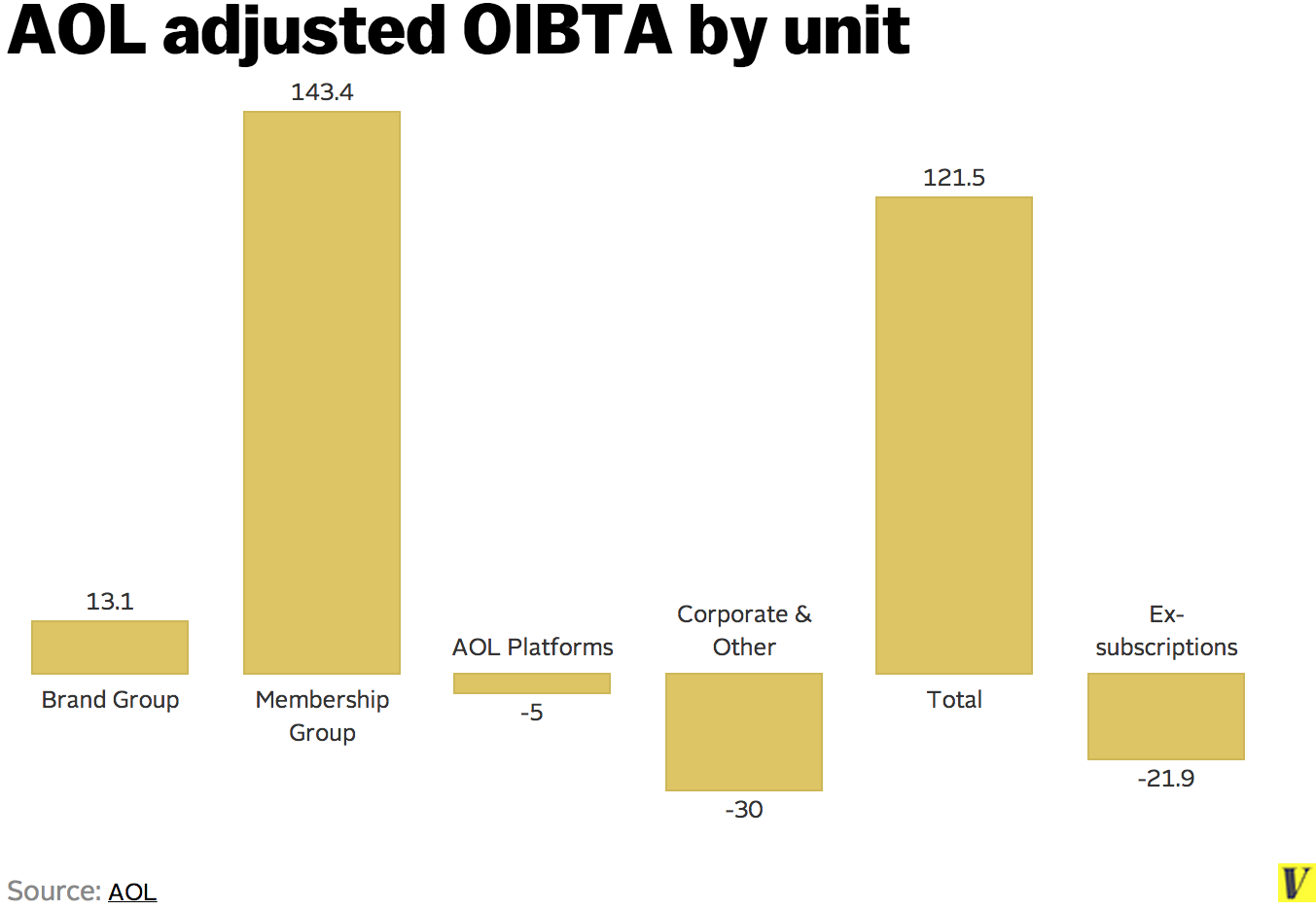
To be quite honest, I hadn't heard about AOL or even thought about AOL in quite a long time but an article today informed me that it turns out they're actually making quite a bit of money. AOL (known as America Online in yesteryear) has recently made a business model out of purchasing content companies such as the Huffington Post and other news outlets. But as it turns out, this isn't primarily where their profit is coming from.

According to AOL's most recent earnings report, most of their profits come from what they call the "Membership Group". You can find the breakdown of their profits organized into a more compact form by Matthew Iglesias over at Vox that I'm showing below:


Iglesias attributes these large profits to people who simply forgot to cancel their AOL subscriptions even though they haven't touched a dial-up modem in years. It is true that the number of households in the US that still use dialup is at a record low of 3%, but that isn't necessarily the only service they provide any more.

If you take a look at the benefits for signing up for an AOL subscription, membership in AARP (only if you're old enough of course) is listed on every plan and the other "features" are grouped into services that either protect your identity, give you "membership deals", offer some sort of convince, or protect your computer. At the bottom of that list is of course dial-up internet access but that service is not what is prominently advertised. Of course most of these things are either available for free in another form or simply aren't of any real value to anybody, but history tells us that people will always succeed at selling us stuff we don't need.

To me, it appears that the success of the AOL subscription model is not to provide dial-up internet access, but to also provide services that are overwhelming geared towards technically challenged (or illiterate) individuals, namely the elderly. The AOL plans bill themselves as aids to navigating the internet safely and simply, which, as any person who has helped a senior citizen with their tech needs knows, is one of their biggest concerns. These users are also probably less aware of free alternatives, rely on brands they "trust", and really don't know how to evaluate the costs and benefits of these services.

That said, AOL is currently losing subscribers and the rate just keeps increasing so people in general don't want what AOL has to offer. My guess is that AOL subscribers are more afraid of changing their habits in an uncertain wired[/wireless] world than spending between $7 and $26 per month and potentially losing some semblance of familiarity. Either way, this isn't a sustainable business model for them.

Wednesday, August 6, 2014

The animated GIF is for more than just memes


It isn't very often that you hear the animated GIF referred to as anything other than an internet meme.
Artist Erdal Enci, however, uses the it as a brilliant artistic medium for making some mind-bending animations. He overlays videos of himself doing various things often with extremely long exposures. The result is an incredible interplay between light, motion, and pattern.